Best Coffee Makers: A Buyer's Guide to Every Type
How we write these guides: we research manufacturer specifications, expert guidance, and owner feedback. We do not claim to have lab-tested every product. Links to Amazon on this page are affiliate links; see our disclosure.
The best coffee maker is the one that fits your routine. A busy weekday needs speed, while a slow weekend morning can handle a pour-over. Below we break down the main types, what each costs to run, and the features that actually change how your coffee tastes.
Browse coffee makers on Amazon
The main types
Drip coffee makers brew a full pot and are the simplest choice for households that drink several cups. Single-serve pod machines are fast and consistent but cost more per cup and create more waste. Espresso machines make concentrated shots for lattes and cappuccinos, with a steeper learning curve. Pour-over and French press setups cost little and give you full control, but they take more time and attention.
What affects taste
Water temperature matters. The Specialty Coffee Association certifies home brewers that heat water to roughly 195 to 205°F and finish brewing in a reasonable window, so a certification is a useful shortcut if you want a drip machine that brews properly.
Freshness and grind matter even more. Whole beans ground just before brewing taste better than pre-ground coffee. A burr grinder produces a more even grind than a blade grinder. A common starting ratio is about 1 part coffee to 15 to 17 parts water by weight, adjusted to taste.
Carafe and warming
Thermal carafes keep coffee hot without a heating plate, which prevents the burnt flavor that comes from coffee sitting on a hot plate for an hour. Glass carafes are cheaper but rely on a warming plate. If you drink coffee slowly, choose thermal.
Size and counter space
Check the water tank size and the height under your cabinets. Some machines need to be pulled out to refill. Programmable timers are useful if you want coffee ready when you wake up.
Maintenance
Descale every one to three months depending on how hard your water is, using a descaling solution or white vinegar followed by two clean water cycles. Wash removable parts after each use. Mineral buildup slows brewing and can affect taste.
Quick buying checklist
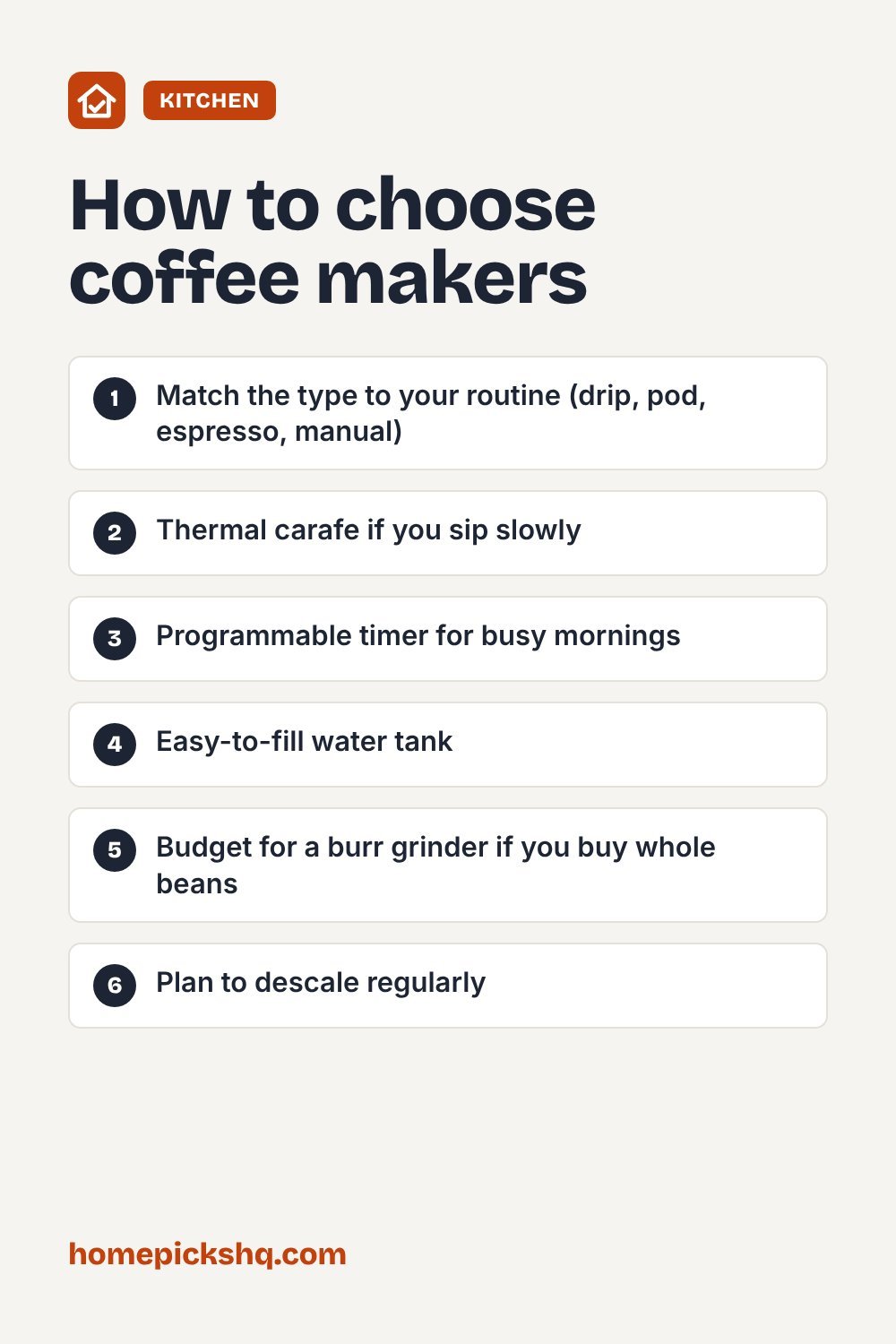
- Match the type to your routine (drip, pod, espresso, manual)
- Thermal carafe if you sip slowly
- Programmable timer for busy mornings
- Easy-to-fill water tank
- Budget for a burr grinder if you buy whole beans
- Plan to descale regularly
See coffee makers on AmazonUse the checklist above to compare options. As an Amazon Associate I earn from qualifying purchases.
Frequently asked questions
Is a pod machine cheaper?
The machine can be inexpensive, but the cost per cup is usually higher than brewing ground coffee.
How much coffee per cup?
A general starting point is about two tablespoons of ground coffee per six ounces of water, then adjust.
Why does my coffee taste bitter?
Common causes are a grind that is too fine, water that is too hot, over-extraction, or an unclean machine.